
IBM Could Be Saving Confluent's Bacon

IBM (NYSE: IBM) has announced plans to acquire data streaming vendor Confluent (Nasdaq: CFLT) in a move that highlights the growing market for high-speed data streaming and event processing, which IBM estimates at north of $100 billion. It also spotlights the challenges companies have monetizing open-source software.
Confluent was founded by current CEO Jay Kreps, Neha Narkhede, and Jun Rao, who are credited with creating Apache Kafka, an open-source technology for real-time capture and streaming of data from various sources in applications such as live financial transactions. The trio developed Kafka while working at LinkedIn, then left that company in 2014 to found Confluent to commercialize Kafka.
Confluent went public in June 2021, raising about $828 million through the sale of 23 million shares priced at $36 each. With initial excitement, the stock rose to almost $90 in late 2022. Over time, however, the firm’s overall stock performance has been disappointing. Even though the price spiked 30% today on the $31-per-share offer from IBM, that offer is below the original IPO price.
IBM management said the company will spend cash to buy Confluent, in a deal valued at $11 billion. They expect the acquisition to be accretive to adjusted EBITDA within the first full year after the deal closes in mid-2026 (pending regulatory and shareholder approvals), and to contribute to free cash flow the second year after closing.
IBM will hire on Confluent’s management and employees as Confluent becomes a wholly owned subsidiary of IBM.
Two Is Greater than One
IBM CEO Arvind Krishna said IBM’s purchase of Confluent snaps easily into IBM’s stated hybrid cloud/AI strategy. On a call for investors today, he cited BMW, Citi, SAP, Bosch, Humana, and Walmart as Confluent customers. It's a question, though, how many of the startup's 6,500 customers are as large as those cited.
This means Confluent could use IBM’s 175-country market reach, plus synergies that could envelope its Kafka capabilities into IBM’s application integration products, as well as perhaps augment Red Hat’s Streams for Apache Kafka (formerly Red Hat AMQ Streams). According to IBM CFO James Kavanaugh, these various product melds could result in “$500 million worth of run-rate synergies.”
The Open Source Conundrum
The Confluent acquisition could boost IBM’s presence in data streaming and event processing, a market that carries some ironies. For instance, Confluent says it primary competition comes from internal IT teams using Kafka and other open-source solutions. Other competitors include data streaming offerings from Confluent partners AWS, Azure, and Google Cloud, as well as from third parties including Cloudera, Oracle, and TIBCO. Many of these competitive solutions are also based on Kafka—all of which points to Confluent’s difficulty in trying to monetize an open-source product.
It's a plan that traditionally hasn’t worked well in the market. Take HashiCorp, for instance, which faced a firestorm of criticism in 2023 when it shifted its Terraform products from open-source licensing to Business Source Licensing. Hashi took the step because business was suffering and its stock had collapsed. Ultimately, HashiCorp wound up in IBM’s stable.
Is Confluent following in HashiCorp’s footsteps? Not exactly. The vendor’s Q3 earnings report showed subscription ARR, which accounted for 96% of revenues, up 19% year-over-year (y/y) to $286 million. Its managed service, Confluent Cloud, grew 24% y/y. And remaining performance obligations increased 43% y/y.
While Confluent’s business prospects look good on paper, its stock hasn’t done well and has lost over a third of its value since the IPO, with few signs of serious growth since then.
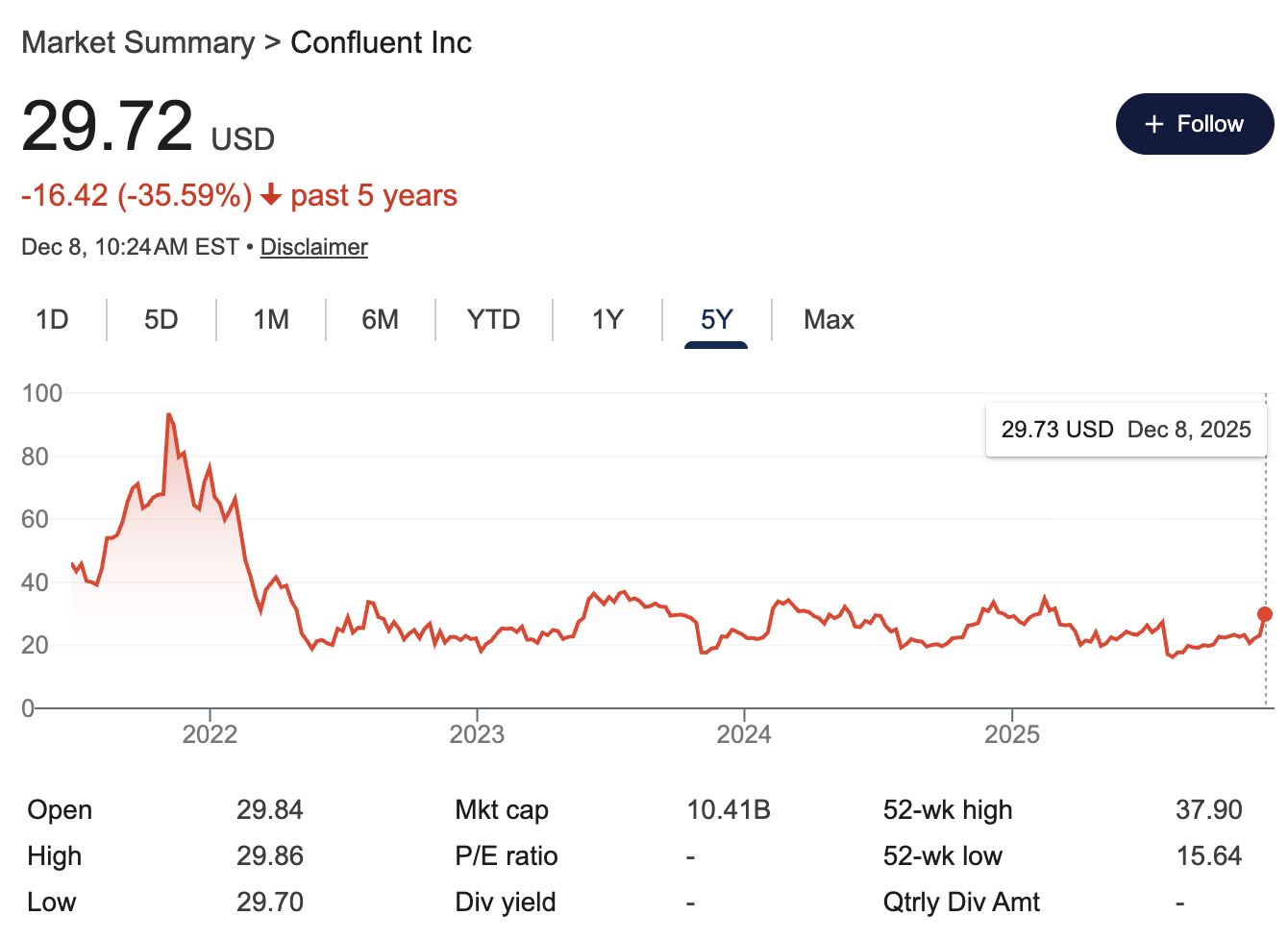
Source: Google
IBM’s substantial resources could boost both Confluent's sales as well as IBM’s potential in this market. “Overall, we view the acquisition as a strategically logical step for IBM,” wrote Jason Ader of William Blair in a note today. “For Confluent shareholders, the valuation premium and all-cash consideration represent a constructive outcome given inconsistent financial execution and the value of being part of a larger portfolio with global distribution.”
Futuriom Take: IBM’s acquisition of Confluent could benefit both parties by giving IBM more technological leverage in a key data management market, while ending Confluent’s struggle in the public markets and broadening its potential reach worldwide.