Enterprise AI Profile: Uber Streamlines Backend Services But Pays a Price

Organization: Uber
Vertical Industry: Transportation and Logistics
Description: Uber operates a global mobility and delivery platform spanning ride-hailing, food delivery, and freight logistics. While its marketplace apps connect millions daily, behind the scenes the company is running a massive operational experiment, successfully scaling low-code automation and agentic AI software engineering to manage its 34,000 corporate employees.
To manage internal operations, Uber's Business Technology Engineering Team migrated from an expensive third-party administrative tool to a custom app built using Google AppSheet and Google Workspace. This tool handles backend services for Uber's Service Desk, IT Operations, and Support Teams, managing thousands of Google "room resources" and over 100,000 Google Groups. By moving this infrastructure in-house, Uber was able to see a 98% cost reduction compared to using the previous vendor.
Unfortunately, this success was quickly followed by a massive development inside its core engineering division. Uber unexpectedly burned through its entire 2026 AI coding budget within the first four months of the year due to rapid internal developer adoption. Uber rolled out Anthropic’s Claude Code and Cursor to its engineering organization in December 2025. Internal usage skyrocketed instantly, jumping from 32% of developers in February to 84% "agentic coding users" by March. By spring, 95% of Uber engineers used AI tools monthly and about 11% of live backend updates are now written entirely by autonomous AI agents with no human in the loop.
Because tools like Claude Code operate on consumption-based token billing rather than predictable flat-rate licenses, costs exploded, with heavy-using engineers racking up bills between $500 and $2,000 a month. Developers were initially incentivized to use the tools as much as possible, actively competing on internal usage leaderboards.
This unbridled consumption has forced a strategic pivot for the remainder of 2026. Uber leadership quickly realized that maximizing token usage does not automatically translate to delivering value, creating an issue dubbed "tokenmaxxing." Chief Operating Officer Andrew Macdonald noted that it is very hard to draw a straight line between the volume of tokens consumed and shipping better products. To curb spending, Uber implemented strict budget caps, enforcing a monthly limit of $1,500 per employee for agentic coding tools, though engineers can request special permission to exceed the limit.
The structural shifting of Uber’s corporate landscape is also moving fast on a separate track. On June 3rd, Uber executed a major internal restructuring, slashing 23% of the jobs within its People and Places division. The layoffs targeted human resources, recruitment, workplace facilities, and culture teams.
In an internal memo, CEO Dara Khosrowshahi stated that the changes are necessary to maximize the effectiveness of the People team and the enormous potential ahead for the company. While Uber explicitly states these HR cuts are purely structural and unrelated to direct AI replacement, the restructuring highlights a significant pivot in corporate priorities.
AI Platforms and Models Used: Anthropic Claude Code; Cursor; Google AppSheet; Google Apps Script; OpenAI Models
Key Success Factors: Building its custom Google AppSheet administrative platform allowed Uber to achieve an almost 98% cost reduction from its previous third-party software platform, reducing internal Time to Resolution (TTR) by more than 95% through automated backend scripts. In software engineering, the deployment of agentic coding tools resulted in 70% of code production being AI-generated, drastically accelerating developer velocity.
Futuriom Take: Uber's aggressive AI strategy showcases the double-edged sword of agentic automation. The unbridled deployment of consumption-based AI coding agents blew through an entire annual budget in 120 days. The introduction of mid-year token budget caps and targeted structural layoffs in the HR division underscore the fine line corporate leaders must walk between engineering efficiency and disciplined financial management.
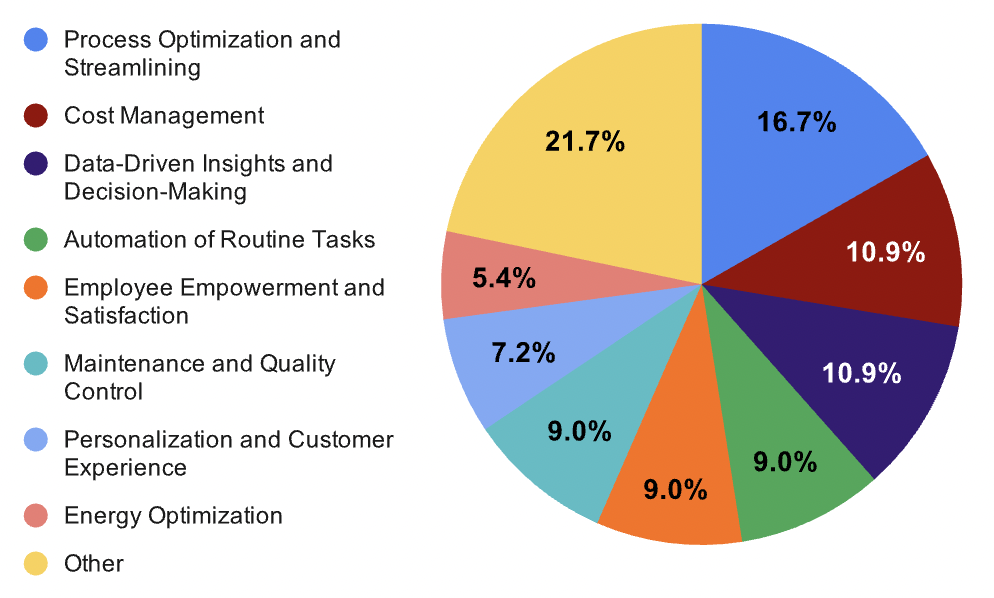
Note: Futuriom's data highlights that for a logistics and mobility platform like Uber, the primary benefits of AI are split evenly between back-office process automation and developer platform engineering.
Related Articles