Hyperscaler AI Spending Doubts Rising

Is cloud capex sustainable?
As the first calendar quarter of 2026 closes, there are two camps forming in the tech markets: One sees a rosy future for all things AI, while another sees a bubble of doom. And there’s a middle ground occupied by those who hold out hope for AI while viewing with skepticism hyperscalers’ hyper investments in it.
How much capex is too much? That’s a question worth asking, as Alibaba, Alphabet, Amazon, Google, Meta, Microsoft, and Oracle continue to pour hundreds of billions of dollars into funding the training and inference of AI, along with bankrolling the infrastructure for OpenAI, Anthropic, and other model builders.
For 2026, hyperscalers have pledged close to $700 billion on capex, much of it going into the coffers of NVIDIA, whose GPUs form the backbone of AI processing and whose CEO Jensen Huang is the champion of the pro-AI party, as well as one of its chief investors. Still, it looks as though, armed with as many GPUs as they can possibly afford, the leading public cloud players could be on their way to a financial stumble, if not a fall.
Trouble Is Brewing in Hyperscaler Capex
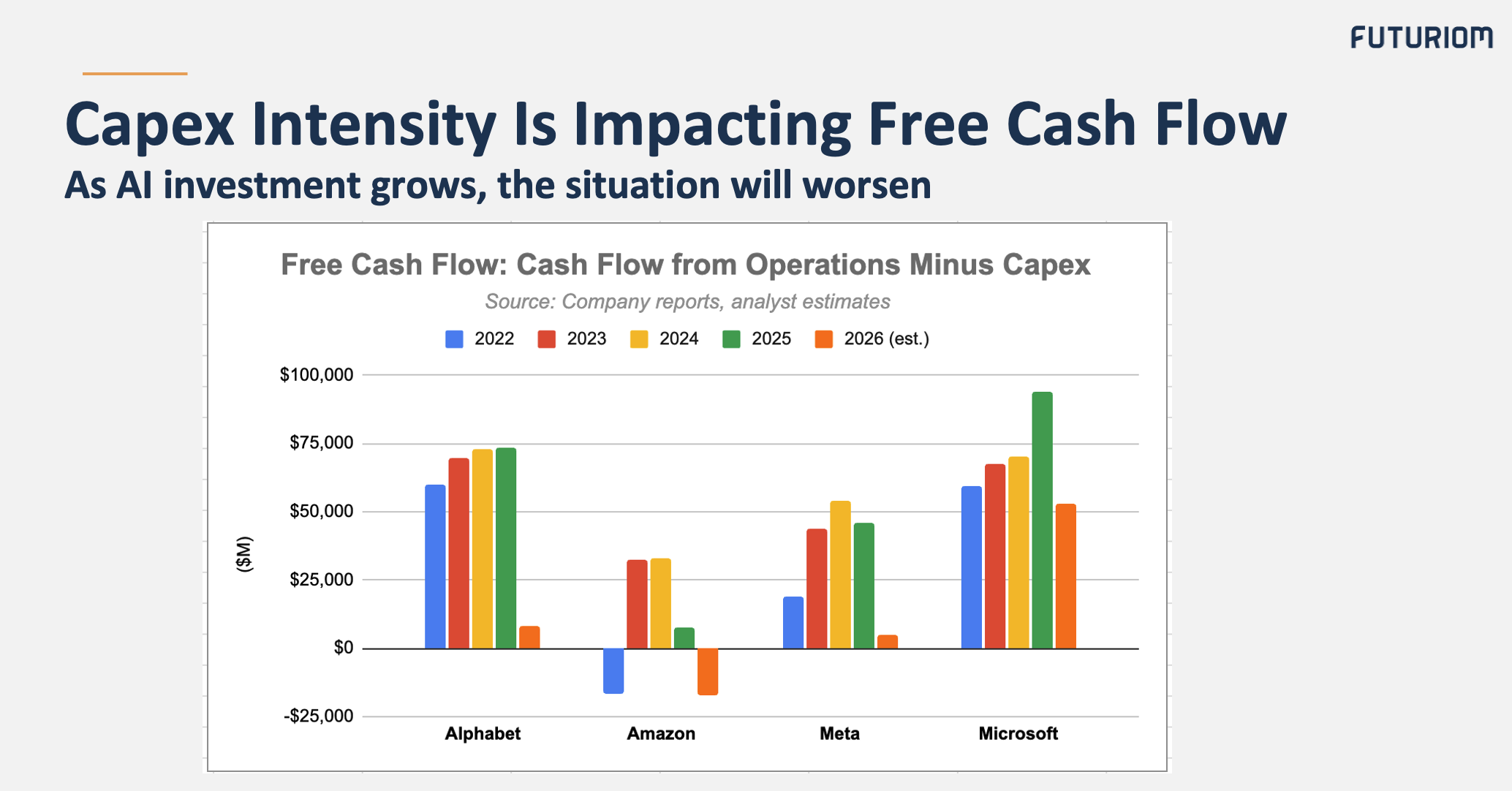
Digging into the numbers, it’s clear that the hyperscalers are playing a risky game. In calendar 2025, revenues for Alphabet, Amazon, Meta, and Microsoft grew an average of 16.5%, while capex growth averaged 60%. If this group of four fulfills their plans for 2026, revenues will grow an average of 15.5%, while capital spending will grow an average of 80%.
With capex outstripping revenues, it’s no surprise that key financial indicators are affected. Free cash flow, or cash flow from operations minus capex, is trending downward among the hyperscalers, with estimates for 2026 looking abysmal, as illustrated below:
Adding to hyperscalers’ woes are some hard facts about the datacenter buildouts most of them are funding. High fuel costs resulting from the war in Iran, troubles in the private credit sector, and grassroots opposition to datacenter buildouts are threatening hyperscaler projects. And as delays in datacenter buildouts outrun new equipment releases, the cloud providers face growing depreciation costs.
We haven’t forgotten Oracle in all this. That hyperscaler’s financial calendar may not match any other on earth, but its numbers also give us pause. For Oracle's fiscal 2025, capex was 37% of revenues; for the first half of the company’s 2026, capex was 66% of revenues. Further, since Oracle pledged $300 billion in AI infrastructure for OpenAI on September 10, 2025, its stock price has fallen over 57%.
These issues and more are covered in Futuriom’s latest Cloud Tracker Pro Update Report, “Capex Outlook for AI Clouds and Telcos.”
CTP subscribers, click here to view the full report!
A Bit of Good News Amid the Bad
Hyperscalers’ capital spending on AI reflects market demand for AI, AI, and more AI, even as enterprises struggle to make it work. But there is evidence that largescale enterprise projects are realizing gains for companies in the retail, financial services, and healthcare markets. These verticals, which require centralized control to fit tight regulatory profiles, show a strong preference for proprietary AI, even to the point of creating their own models.
These and other details gleaned from Futuriom’s Enterprise AI Index (free to subscribers) are also covered in the latest CTP Update Report.
CTP subscribers can download the whole report here!