Opinion: How NVIDIA's GTC Hype Could Backfire

A trillion here, a trillion there—pretty soon you are talking about real money. Such is the story of NVIDIA’s GTC event in San Jose, where we got an onslaught of huge numbers from NVIDIA, including Founder and CEO Jensen Huang’s prediction of $1 trillion in revenue in the next two years.
Excuse me for a few minutes, while I use approximately 1,200 tokens to push back against the cavalcade of Jensenmania, GTC selfies, made-up numbers, and influencer cheerleaders.
There’s trouble brewing here. NVIDIA is drifting away from its core mission of providing engineering excellence to pumping up Wall St., which is a traditionally risky strategy.
Think Lucent in 2000. That American icon of technology innovation was sucked up into the hype of the Internet bubble and yes, a capital spending boom, leading to an inflation of egos on its executive team. Years later the company lost more than 90% of its value and was sold for scraps.
I know. It’s not fair. NVIDIA isn’t Lucent. NVIDIA is a much better company, even though it is oddly enough resorting to the same vendor-financing techniques that led to the exit of Lucent Service Provider President Carly Fiorina and eventually, Lucent’s demise.
I only point to this out to show that there is real risk to AI Bubble Derangement Syndrome (AIBDS). It’s happening in other areas such as optical components and systems, where shares of Ciena and Lumentum shoot to the moon and the employees won’t listen to anything while they check their stock screens, forgetting about basic laws of supply and demand. In an AIBDS environment, you lose all sense of reality as the unsustainable capital spending (capex) boom levitates stock prices, employee portfolios, and egos.
I’m here to keep you grounded.
AI Capex Threats Abound
The stock prices won’t always go in one direction, and it’s not always going to be this easy. Capex is already showing signs of decelerating. In its recent earnings call, Oracle Corp. maintained its prior capex growth, rather than raising it as many of its rivals have. The reason that Oracle didn't increase capex is likely because investors have been pushing back as capex spending eats into profits. Oracle shares are down 20% year-to-date.
There are reasons to expect further deceleration in AI enthusiasm and capex outlays. Many large enterprises are struggling with large-scale success in AI implementations. AI services revenue growth is disappointing. And there’s a major war in the Middle East, which is driving up the price of energy—the number one resource and bottleneck in the AI boom.
Datacenter projects are being delayed. Sightline Climate recently released research that shows 30%–50% of planned datacenter projects are unlikely to come online before the end of the year. There are a variety of reasons behind this, including energy and financing constraints.
Meanwhile, NVIDIA seems to have escalated its GTC hype strategy, which includes a two-hour keynote, careful curation of which analysts get passes, and a barrage of very large numbers that are difficult to decode. (Disclosure: I was one of the many independent analysts who wasn’t given a pass to GTC, so I decided not to pay to go to a conference that makes the world’s most valuable company even more money.)
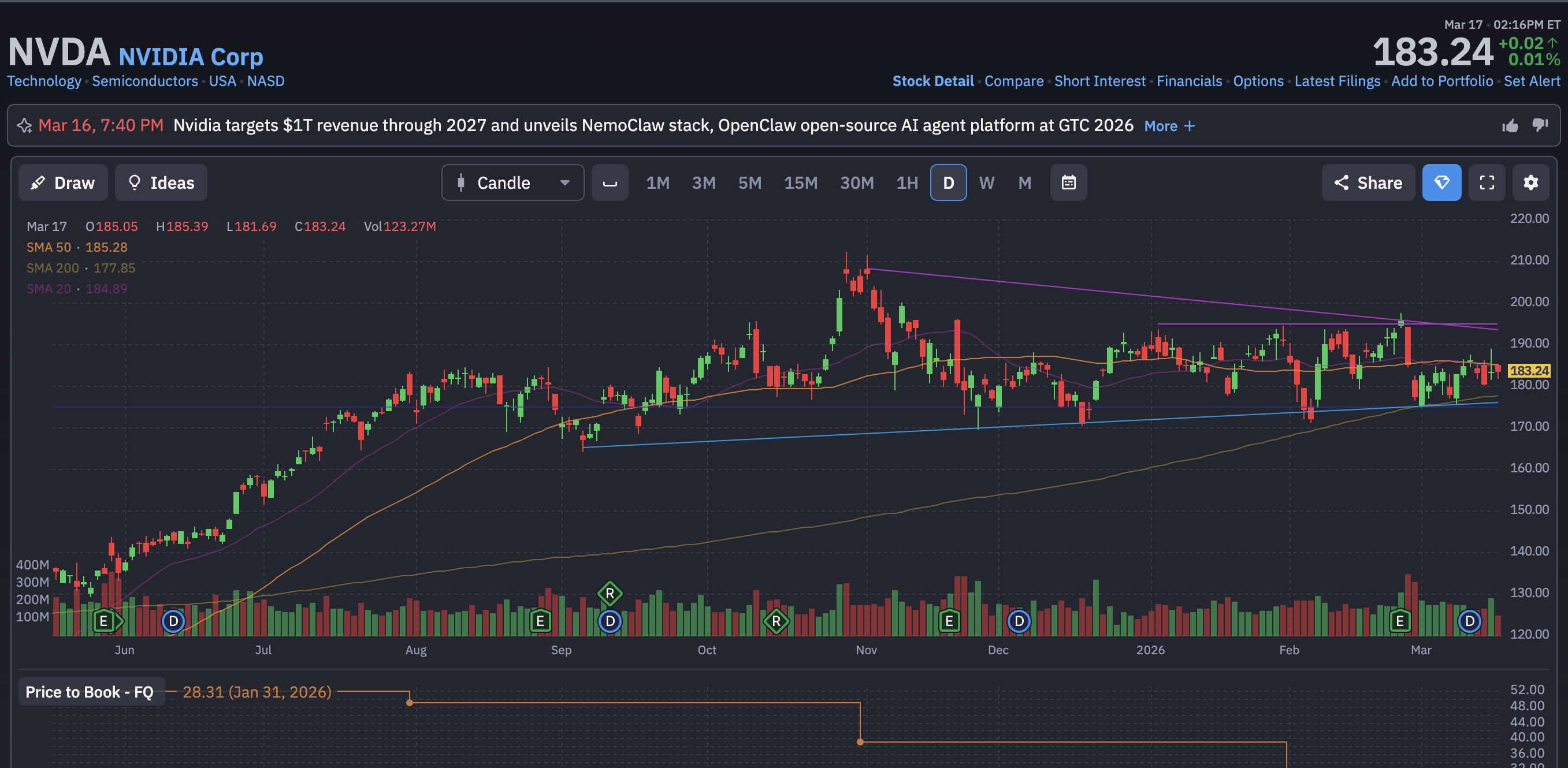
I think it’s already clear that this strategy is becoming less effective, as witnessed by NVIDIA’s subdued stock-price reaction to this week’s GTC. NVIDIA’s shares haven't moved this week, and they haven’t meaningfully appreciated in six months.
A $1 Trillion Number that May Not Be Real
One of the key hype events of the week was NVIDIA CEO Huang’s $1 trillion number. In the GTC keynote yesterday, Huang predicted the NVIDIA would book $1 trillion in revenue by the end of 2027.
Specifically, Huang phrased this as a "$1 trillion revenue opportunity through 2027."
There are two problems with this number. The first is that Wall St. has defined regulations and processes for how you project future revenues or profits—a process known as guidance (“past results are no guarantee of future returns”). Typically, these numbers are disclosed in earnings calls or company press releases. NVIDIA has only released financial guidance for the first fiscal quarter of 2027 (ending in April 2026), which is $78 billion. Huang's new two-year number is ostensibly a "ballpark number" presented as a long-term demand forecast outside the usual conventions of Wall. St. forecasting.
The second problem is that it's hard to calculate what it means. Let’s set aside for a moment that predicting revenue though 2027 is a highly speculative exercise. This new two-year forecast theoretically boosts Huang's prediction from last year (which was $500 billion), but it also includes growth that has already been baked in for 2026, which is a run rate that is expected to exceed $320 billion. If NVIDIA was able to hit $400 billion this year, and then, let's say, $500 billion in 2027, that could in theory be rounded up to $1 trillion but it would also represent a deceleration of growth (the law of large numbers). All we are left with is Wall Street's reaction—which was, meh.
Of course, the slathering press ate it up and printed the $1 trillion number everywhere, which is exactly what NVIDIA wanted. There was probably a communications strategy meeting behind this: “Which soundbite numbers can we produce?”
But this isn’t a one off. NVIDIA and Huang have a habit of making outrageous statements in keynotes and interviews that are repeated everywhere yet seem to be impossible to verify or decode. Let’s look at some examples:
- At CES in January of 2025, Huang concluded that “The age of AI agentics is here” and that it’s "a multi-trillion-dollar opportunity.”
- Huang has claimed that NVIDIA's AI chips today are “1,000 times more advanced” than what the company produced a decade ago. According to Moore's Law, compute power doubles roughly every two years, resulting in a 32-fold increase over ten years. So Huang is saying that NVIDIA's chips provide a 32X return over Moore's Law, which seems both improbable and also hard to prove.
- Huang once said on a podcast in 2025 that AI inference—the act of running trained AI models to answer queries—will become “1 billion times larger” than it is today.
Here's a quick calculation that I ran using (of course) AI: A billion-fold increase in compute power would require 13.9 trillion high-end GPUs operating full-time, consuming roughly 200 times the world's current total electricity generation.
This seems impossible. But notice that like many of Huang's claims, it's hard to prove.
Hype Doesn’t Match End-Users' Frustrations
The problem with this endless sea of huge numbers and fantastic promises is that this type of messaging probably won’t resonate with real-world technology practitioners, who are in fact, struggling with implementing AI.
Most enterprises can’t buy racks and racks of GPUs and plug them in to produce their AI. And, in fact, only a handful of them have the budget, expertise, and scale to run to NVIDIA’s ecosystem of captive neoclouds and buy huge GPU services. Enterprise technology practitioners are currently showing real signs of AI exhaustion, as they are driven by boards and business peers to implement AI infrastructure—but finding that the costs, as well as the risks, can be exorbitant.
Don’t take it from me. Google AI agrees. When I asked Google AI what technology practitioners are saying on leading technology forums, including Reddit, it replied that “AI infrastructure is described as incredibly expensive, with massive hardware costs and complex management requirements for clusters."
Our own AI Enterprise Index shows that AI deployment is progressing, though it’s focused on a handful of leading industries with specific use cases. AI deployments are concentrated in the financial, healthcare, and retail verticals. Our index also shows that these deployments are skewing toward private clouds, not public clouds where the bulk of capex is occurring.
NVIDIA’s current hype amplification strategy seems to be primarily targeting the fan hobbyists and Wall St. investors with AIBDS, not enterprise adopters. And that’s dangerous for the company and markets in the long run, as it risks focusing on the wrong things, inflating expectations and falling short on delivery.
I have no doubt that Huang is one of the great visionaries and technology geniuses of our time. But Huang’s focus on superlatives and hype have simply grown too large, perhaps to match the pressures of the market. In the end, that may not be good for adopters (or investors).