
Resolight Wants to Restart the All-Optical Revolution
All-optical networking with photonic processing has long been considered the "holy grail" of the networking industry. With AI data pushing networks to the limit in datacenter architectures, it's considered the long-term solution to network and bandwidth constraints by many industry luminaries.
Resolight, a nascent Israeli company with high-powered intellectual property (IP) in photonic processing, thinks it has the answer. Resolight is led by industry veteran Cofounder and CEO Ofer Shapiro, who holds 52 patents and invented multicast video technology still used by dozens of companies, including Google and Cisco. He has a history of approaching technology problems with new architectures.
Queue up your Leonard Nimoy voice, as we look at this new photonic processing technology.
In Search of ... All-Optical
All-optical photonic processing technology is so exciting that many industry experts still refer to it as the holy grail. In short, photonic processing does not require conversion to electronic technologies to switch and route packets, which is the current norm in the industry. Photonic processing keeps all of the network switching in the optical domain (light), which is much cheaper and handles orders of magnitude higher bandwidth.
In my 35-year-plus career in networking (embarrassed to say it's been that long), I've heard about all-optical switching and/or photonic processing for almost as long. Back in the heyday of the first optical bubble (1998-2000), when we were covering dozens of startups at Light Reading, a number of all-optical startups came and went, promising all-optical switching using technologies ranging from MEMs (micro-electromechanical systems) to using exotic things like planar lightwave circuits. Some of you might remember a famous startup called Corvis, which staged an Initial Public Offering giving it a market capitalization of more than $50 billion. There were others, including Calient and Qtera.
For a variety of reasons, this surge in innovation didn't stick, and most of these companies went away. For years the hope of all-optical switching and photonic processing was laid to rest, except for pocket use cases such as Google's MEMs switching. Leading optical networking suppliers such as Ciena, Cisco, and Nokia today are largely supplying OEO (optical-electrical-optical) switches for optical networking in datacenter networks.
Now Resolight is promising to shake up the industry with new photonic processing technology developed by industry engineers with track records of shaking up technology markets with innovative architectures.
We have explained the industry challenge and Resolight's technology in a new Leadership Brief, but let's dive deeper into the problem and why a solution is needed. (Disclosure: Futuriom has partnered with Resolight on a research engagement and this Leadership Brief.)
The Network Is a Bottleneck for AI
With both NVIDIA's GTC and the Optical Fiber Conference (OFC) happening next week, you are going to hear a lot about networks, specifically ones using optical technology. The networks need to be advanced to enable connectivity in the most advanced AI datacenters.
AI services require huge amounts of compute, networking, and storage infrastructure. This infrastructure also requires immense consumption of power, increasing operating costs. When you combine the major hyperscalers with GPU clouds and altscalers, Futuriom expects nearly $1 trillion to be spent on capex for AI and other cloud infrastructure.
At the same time, the return on investment (ROI) for these services is unknown, so the economics of operating this infrastructure will be a key factor in determining the success of AI services. The operators need to reduce costs.
Networking will be the key to it all. The connectivity among GPUs, CPUs, TPUs, racks, and systems remains a large bottleneck in delivering hyperscale AI datacenters. It also contributes to the huge energy and datacenter real-estate footprints.
At the current rate, networking will escalate in cost, even though it is generally held to be 8%-12% of the total datacenter cost. As tens of millions of GPUs are shipped to datacenters around the world, they require millions of electronic switches and hundreds of millions of network connections, which come with huge energy consumption and massive complexity.
The bottom line: Key innovations will be needed in the area of networking to support the massive scaling of millions of GPUs and trillions of dollars in datacenter capex.
Resolight Targets the End of OEO
Resolight came to us with a compelling proposition: What if you could reinvent the networking architecture for datacenter switching, to increase scale and reduce costs by a factor of ten?
Sure, sounds great. In our discussions with other networking vendors, it's clear that something has to happen. NVIDIA has pushed the limit of using copper inside the GPU racks with NVLink, but more importantly, the industry is looking at installing millions of electronic switches at the tops of racks in "scale out" and "scale across" configurations to connect a mind-boggling array of AI compute and storage devices.
The challenges are clear, with the primary concern being the cost of all of these electronic switches, both in terms of energy and capex. The reason the industry has been searching for all-optical technologies for decades is that when you are switching networking packets in the electronic domain, the optical transceivers connecting networks over longer distances than copper connections (typically out of the server rack), must use OEO switching to route the packets. That means the end of every optical connection must be converted back to electronic switching and then back to optical for transmission. This has tremendous costs is the use of extra power, components, and equipment.
Hence, the perpetual search for all-optical technology. To be more specific, the industry needs photonic processing, which can route and switch traffic in the optical domain without electronic conversion. Resolight says its photonic processing technology will reduce the number of switches needed by 90% and increase bandwidth by 10X. See below for how this works.
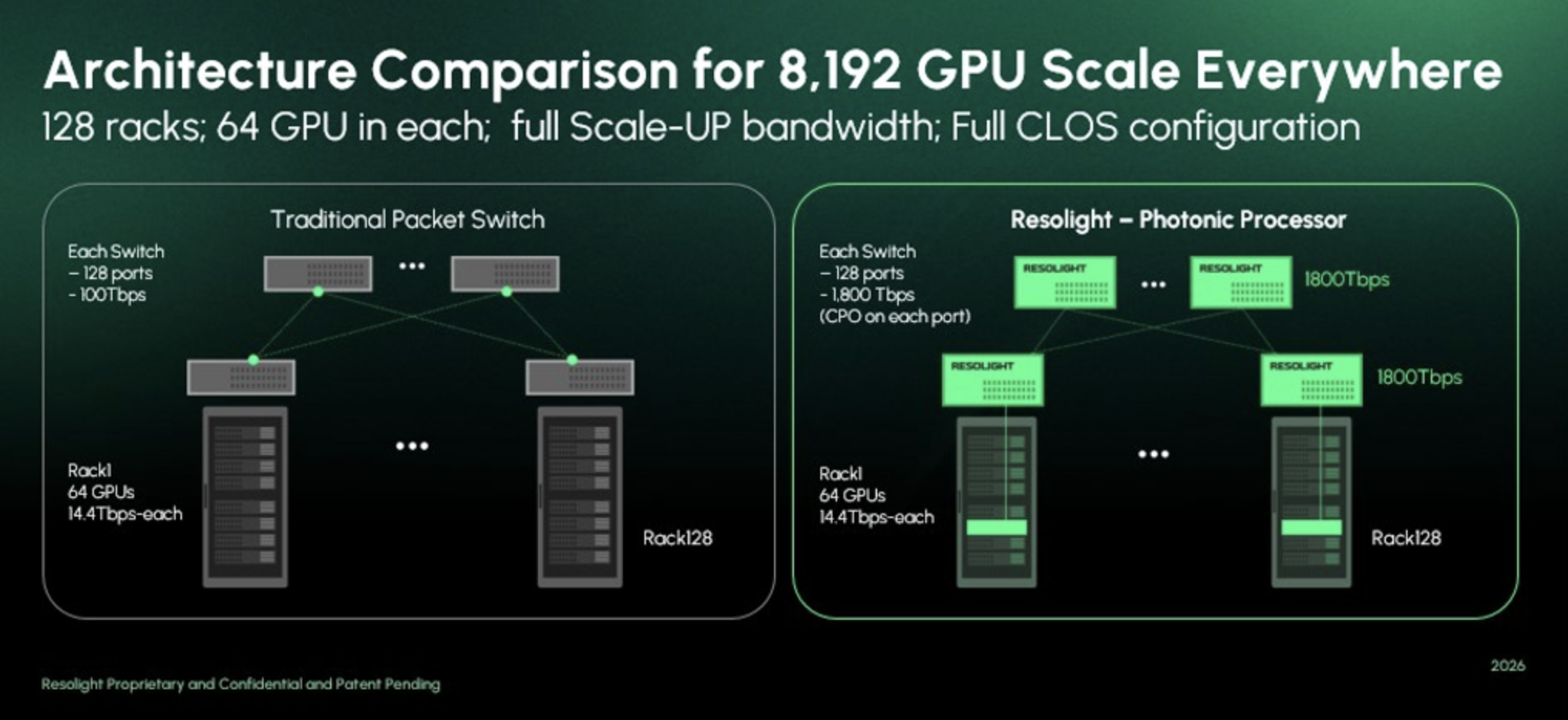
Source: Resolight
Many industry leaders, including NVIDIA, Broadcom, Cisco, Arista, and others, have talked about how advances in optical networking are needed. Many of these discussions have focused on solutions such as co-packaged optics (CPO) or linear pluggable optics (LPO). NVIDIA itself recently announced a $4 billion investment in CPO development with Lumentum and Coherent.
So far, proposed solutions such as CPO or LPO are only a piece of the solution. CPO technology is exciting as a means to provide a more efficient way for GPUs to communicate directly with optics. Better LPO will also help improve the economics of energy and space. However, sending massive amounts of data over lightwaves into OEO networking gear without matching it with equally powerful optical processing capability doesn't solve all of the switch scaling challenges. To really move the needle, what’s needed is a vast architectural shift to end-to-end optical networking, delivering order-of-magnitude gains in bandwidth, power efficiency, and cost.
Resolight has built compelling technology to solve these problems. More importantly, it has a unique architectural vision for how it can solve all of these problems by massively reducing the costs and footprint of networking infrastructure.
To find out how, read up in our latest Leadership Brief, "Scale Everywhere: How Resolight’s Photonic Processing Could Revolutionize AI Networking." (Sponsored by Resolight)