
What's Up with NVIDIA's Latest Financial Model?

NVIDIA shares tumbled on recent news that the vendor will guarantee the sale of GPU capacity for selected AI cloud providers (aka neoclouds) over several years. In return, NVIDIA will share in revenues earned above the guaranteed, or backstop, level.
The point of this new model is to allow what NVIDIA terms “startups, model builders, enterprises, research organizations and regional AI players” access to better terms from neocloud service providers.
Up to now, those cloud providers have been demanding contracts of long duration to sustain their own spending. With NVIDIA backing them up, these cloud providers will get better terms from their creditors. In turn, they can afford to offer shorter-term contracts to smaller organizations that have cash but lack the capital to buy the infrastructure they need.
In other words, instead of foregoing expensive neocloud services to get the GPU power they require, startups and other smaller-than-hyperscaler organizations can get those services without having to build their own infrastructure.
Here’s how NVIDIA CFO Colette Kress and VP of Global AI Clouds and Infrastructure Ecosystem Raj Mirpuri described it in their joint announcement blog:
“This new model enables AI clouds to procure NVIDIA infrastructure for AI-native, enterprise and ISV customers through economic alignment with a revenue-sharing and credit-support model. Through the partnership, AI clouds will sell NVIDIA-powered cloud services, with NVIDIA earning both standard product revenue and a share of the cloud revenue on the supported capacity. This structure accelerates adoption of NVIDIA platforms among the high-growth, high-conviction AI native sector, and provides NVIDIA with a recurring, usage-linked earnings stream.
“For model builders, inference providers, agent platforms and enterprises scaling AI, it can mean faster access to full-stack accelerated computing without waiting through site selection, power procurement, construction and hardware bring-up.”
NVIDIA states that two AI cloud providers have already signed on for the new deal: Sharon AI, based in Australia, will buy up to 40,000 NVIDIA Grace Blackwell GB300 GPUs under the plan. Firmus, based in Indoesia, is building a DSX AI factory there that’s expected to scale to 360 megawatts and contain up to 170,000 NVIDIA GPUs.
There is a precedent to the new NVIDIA model. NVIDIA reportedly has had a backstop deal with CoreWeave since 2023, in which it has agreed to pay up to $6.3 billion through 2032 if the cloud provider fails to sell a specified amount of NVIDIA GPU capacity.
What’s Not to Love
It all sounds great, doesn’t it? Everyone benefits—the service provider, the end customer, and NVIDIA. So why did NVIDIA’s stock tank the day of the announcement?
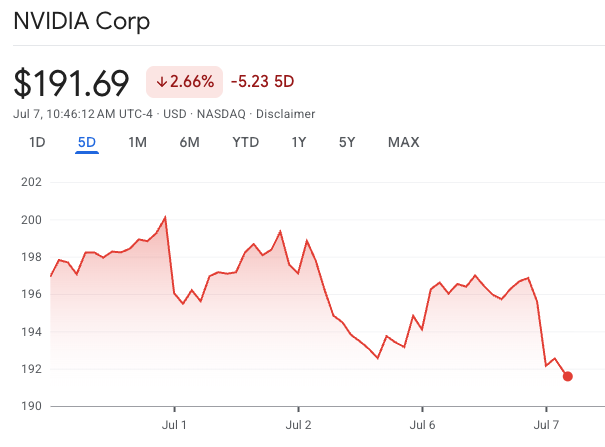
Source: Google
It seems that investors aren’t entirely convinced that NVIDIA is right about AI compute demand. After all, some say, the hyperscalers are selling spare GPU capacity they themselves can’t use, implying that they’ve overbuilt their AI factories.
On July 1, the same day NVIDIA announced its new revenue-sharing model, Bloomberg reported that Meta is setting up a cloud-based business selling AI compute and models. If Meta, which planned to buy “millions” of GPUs from NVIDIA earlier this year, now doesn’t need those chips, what does that say about AI demand? Consider how NVIDIA CEO Jensen Huang described Meta at the time:
“No one deploys AI at Meta’s scale—integrating frontier research with industrial-scale infrastructure to power the world’s largest personalization and recommendation systems for billions of users.”
Apparently, that enormous demand has been met, turning investors skeptical about the ongoing scale of hyperscaler AI infrastructure—and by association, the scale of AI demand in general.
More Circularity?
NVIDIA’s latest financial model also points to investor concerns that NVIDIA tends to circularity in its dealings. Investing in CoreWeave, for instance, has provided NVIDIA infrastructure to customers such as OpenAI, in which NVIDIA has also invested. Revenue sharing with cloud providers also pays NVIDIA for selling its own chips. The complex, circular nature of these deals is one of several concerns about NVIDIA raised by investors over the past few months.
NVIDIA CEO Jensen Huang has called these concerns “ridiculous," and he maintains the ongoing need for GPU power: "Without compute, there's no way to generate tokens. Without tokens, there's no way to grow revenues. In this new world of AI, compute equals revenues," he said on the Q4 FY2026 earnings call in February 2026.
Nevertheless, doubts persist. NVIDIA’s stock also suffered this week because research firm SemiAnalysis stated in an X post that NVIDIA’s Kyber NVL144 rack system has hit manufacturing setbacks—a situation that could be further impetus for NVIDIA to deploy its new credit and revenue-sharing model, creating a continuing flow of demand for its products.
An NVIDIA spokesperson said, “Our road map is intact.” Further, "Vera Rubin Ultra will scale up to a larger NVL576 domain in its planned 2027 timeline."
Futuriom Take: NVIDIA’s new business model for AI cloud providers could boost demand for its GPUs among startups and other small enterprises. But investor doubts persist about the scale of AI demand and the circular nature of some of NVIDIA's arrangements. We’ll see what a few quarterly reports reveal.