Neocloud Infrastructure Trends from the RAISE Summit

Last week I had a nice trip to Paris for the RAISE Summit, which highlighted the booming AI infrastructure market, drawing 9,000 attendees to discuss enterprise AI, coding tools, and the evolving neocloud sector.
Overall, the content was excellent, including speakers from a range of AI companies, with the makeup heavily focused on AI labs and neoclouds, which also happen to be the epicenter of AI risk.
There were some key themes that stood out:
- AI geopolitics are elevating needs for data sovereignty and security. This should benefit the cloud providers and technology providers alike who make it easier to segment and protect data.
- Tokenmaxxing is dead. Enterprises have quickly realized they can’t afford to spend unlimited budget on AI tokens, and they are seeking more rational and cost-effective approaches, including routing between models, including open source.
- The neocloud supplier ecosystem is rapidly evolving, as innovation fills in the gaps and looks to solve key problems such as cost, availability, data sovereignty, and fault tolerance. The neoclouds that solve these problems will be the survivors.

Macron Calls for AI Sovereignty
Let’s start with the rising need for data and AI sovereignty. Enterprises are increasingly prioritizing data sovereignty, seeking model-agnostic architectures, and adopting open-source AI models to avoid vendor lock-in and protect proprietary data, signaling a shift toward custom, secure deployments. The summit's rapid growth underscores the dynamic expansion of this critical market.
French President Emmanuel Macron urged European AI independence and data sovereignty, while investor Mark Cuban emphasized AI's role in accelerating innovation and fostering a startup boom. A key theme was the emergence of neoclouds as future "mini hyperscalers," expanding beyond GPU rentals to offer global infrastructure, application services, and enhanced data privacy.
Cuban, speaking in an interview with Lovable Cofounder Anton Osika, said the explosion of AI tools is accelerating innovation and fueling a startup boom. But more importantly, he said, it’s enabling people to unleash creativity and create apps and translate ideas into code faster.
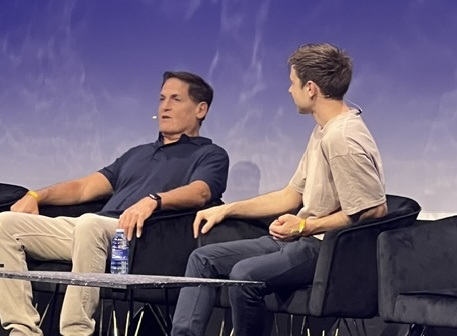
"Your biggest limitation is your time and your imagination,” said Cuban. “The number of startups is accelerating dramatically. As things change, there is more opportunity. France is becoming more entrepreneurial.”
In an interesting panel on “AI Pilot to Production: The Valley of Death and How to Cross It,” a range of experts weighed in on the many real-world challenges of implementing AI in production, including token costs and data protections.
Barak Kaufman, Chief Strategy Officer of Wonderful, said the chief challenge in enterprise continues to be the search for a return on investment (ROI).
“For many enterprise organizations, they are starting to calculate the ROI. It has to come from revenue as well as cost savings,” said Kaufman. “Tokenmaxxing is definitely the wrong approach. You need to figure out in which situations you want to have an open-source model, but for certain use cases. The biggest execution gap is the change management.”
Kaufman said the discussions in boardrooms often vary widely from the hype promoted by vendors. But a key trend is avoiding lock-in to high-cost models and experimentation with open-source models.
“What I'm seeing in closed doors is how often the CxOs are [looking] how to have model-agnostic architectures. The answer is not to go all-in on one model. There's not a single enterprise that I've met anywhere that's not thinking about how to avoid model lock-in," Kaufman said.
Andrew Feldman, Cofounder and CEO of AI chip maker Cerebras, told me in an interview that the focus on tokens was always incorrect.
“I don't think we should count tokens,” said Feldman. “We should measure work. We're doing work. Tokens are a very rough measure.”
Jonathan Corbin, Founder and CEO of Maven AGI, which offers an AI agent-building platform, said in a panel that there is a trend toward enterprises protecting proprietary data and not freely giving it to the large frontier LLMs. “They are concerned about that,” he said. “We are seeing more and more people moving to an on-prem deployment. I don’t want people accessing data without controlling that.”
This, of course, is a trend backed up in our Enterprise AI Index, which continues to show that the bulk of enterprises are seeking out proprietary implementations of AI.
The Evolution of the Neoclouds
The bucket of companies called neoclouds is diverse and plentiful, as we profiled in our report last year (there is a new one coming out in October). These alternative clouds can range from more sophisticated, diverse altscalers such as Vultr and Akamai to freshly minted datacenter operations that were converted from cryptocurrency or other datacenter assets, such as IREN and Nebius.
Kevin Cochrane, Chief Marketing Officer of Vultr, started his presentation by saying he had just returned from the North Pole after running seven marathons on seven continents in seven days. That was a bit of an eye-opener.
One of Cochrane’s takeaways? “Polar bears can smell you from 20 miles away and they can eat you.”
Cochrane framed the AI infrastructure buildout as a long-term cycle.
“Are we overhyped? We are just at the start of the journey,” said Cochrane. “The journey that we are on is a supercycle. It's a 30-year era of innovation through the entire compute stack. We are at the dawn of a new compute cycle. We are just getting to the new age where enterprises can deploy AI-native applications."
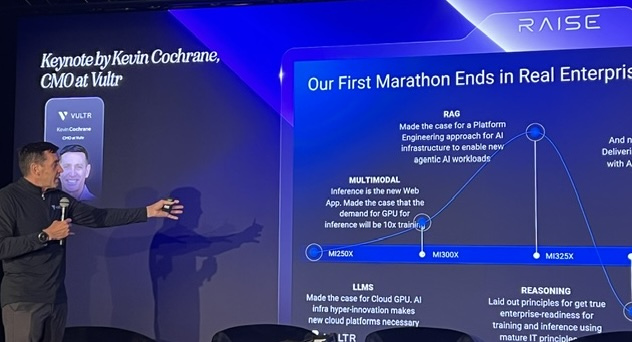
Even if we are on a 30-year journey, that doesn’t mean there aren’t risks, for investors or otherwise. The Internet has a compounded growth rate over 40% per year over the past 30 years, but there were rocky periods in there. With widely reported challenges in maintaining and providing reliability in GPU clouds, a key differentiator will be operational excellence.
The initial core value of neoclouds and altscalers was that they had availability of newer services—or they were cheaper. The hyperscaler clouds generally sell services such as S3 data storage and GPU rental for much higher prices, if they can offer them at all. However, given the trend toward needs for data sovereignty and privacy—as well as integration with on-prem infrastructure—enterprises will demand more sophisticated services such as hybrid data portability and regional data sovereignty zones.
“The gradation of between the very good ones and the ones that don't have as much experience is quite steep,” Clockwork Systems CEO Suresh Vasudevan told me. “The ones at the top of the pyramid, they are making investments in infrastructure and making it robust."
Vasudevan said the top neoclouds are focusing on observability. “You need to measure everything," he said.
Clockwork recently introduced a guarantee for its TorchPass GPU fault tolerance software, offering credits to customers that don’t see results from its product.
Roman Chernin, Cofounder and Chief Business Officer of Nebius, said that the level of sophistication in neoclouds must rise, as customers grapple with issues such as token costs and managing agents.
“We control the infrastructure and go down stack and up stack. You want to deploy the agent that works. You don't want to be an expert on which token is better. What you want is the next layer of abstraction, the platform will run the agent and optimize it," Chernin said.
Orchestration and Automation on the Rise
Neoclouds are building out GPU and cloud compute infrastructure at a massive rate, but they don’t necessarily have the software resources and expertise that large hyperscalers such as Amazon Web Services and Microsoft have. RAISE was attended by many infrastructure orchestration vendors such as Rafay, emma, and Netris; data management companies such as Backblaze, DDN, and Bright Data; and enterprise AI coding and app tool providers such as Cognition and Lovable.
In addition to outright GPU failure, there are other challenges, such as automating GPU services at scale, which requires the capability to partition and provide multi-tenancy in GPU clouds, as well as security and data connectivity to other infrastructure.
Orchestration and automation software is becoming increasingly critical in the neocloud ecosystem. We recently pointed this out in an article about the $15 million funding round for Netris, which helps automate the network build-out of GPU clusters, abstract the fabrics beneath them, and enforce hard multi-tenancy in hardware. Netris labels its approach NAAM, for Network Automation, Abstraction, and Multi-Tenancy, and has become the platform neoclouds standardize on as the category takes shape.
Rafay is another interesting company in this area, providing GPU configuration and automation middleware. Netris partners with Rafay.
“The pattern is the customers want regular compute and AI in the neoclouds,“ Mohan Atreya, the Chief Product Officer of Rafay, told me. “They will evolve into mini hyperscalers.”
Emma is another cloud orchestration company we met with. Based in Luxembourg, emma is providing infrastructure automation and orchestration from every layer of the cloud, from the physical to application layer. “Neoclouds have to evolve from real estate to value add,” Dmitry Panenkov, Founder of emma, told me.
Emma is a next-gen multicloud networking service that can handle all layers from the optical network connection up to the application layer, with built-in agentic AI operations, which it’s calling “Infrastructure-as-Prompt.”
Overall, the RAISE Summit in Paris was a great place to get an inside view on the the booming AI infrastructure market, drawing 9,000 attendees to discuss enterprise AI, coding tools, and the evolving neocloud sector. This fast-growing show has already announced it will move to a new location at the Palais des Congrès in Paris next year, to accommodate the growing crowd size. We look forward to attending it again.