Enterprise AI Profile: Wayfair

Organization: Wayfair
Vertical Industry: Retail
Description: The international e-commerce platform Wayfair operates a vast marketplace of home furnishings, decor, and housewares, connecting millions of products directly to customers from the comfort of their homes. Behind the scenes, the company's Service Intelligence team uses advanced artificial intelligence to predict customer needs in real time, empowering customer support representatives with instant predictions and personalized discount options. To achieve this, Wayfair executed an architectural overhaul, transitioning from slow data processed in delayed chunks to an engine built to handle high traffic instantly, all powered by Google Cloud's Vertex AI.
To streamline this transition, Wayfair completely shifted its machine learning operations from development to deployment. By combining GitHub, MLflow, and Buildkite, the engineering team automated their entire CI/CD pipeline, bundling their AI models into self-contained software packages to be loaded instantly onto Google's cloud servers to handle customer requests. A centralized model controller runs on Google Kubernetes Engine (GKE) to manage all incoming requests, pulling features from the Vertex AI Feature Store and directly logging predictions into BigQuery for continuous model updates and offline analyses.
This backend foundation paved the way for Wayfair's consumer-facing generative AI strategy, designed to capture the visual inspiration phase of home design. The company launched Muse, an AI-powered discovery tool integrated directly into its digital shopping experience that acts as a conversational inspiration engine. Instead of navigating transactional keyword filters, customers can input specific natural language prompts, such as "moody 1920s style living room" or "dining room with a coastal vibe," to instantly generate styled room environments. Customers can even upload photos of their own physical spaces to see how these curated design collections would look in their homes.
Bringing this smart technology directly onto the iPhone, the company combined its own application development with Apple's built-in operating system capabilities to create a seamless, hands-free summary feature right on the product page. Instead of making customers scroll through long descriptions or query an interactive assistant, the app uses the phone’s on-device AI to automatically read product details and slide up a bite-sized overview card at the bottom of the screen. Once loaded, these summaries are saved for the duration of the customer's shopping session, keeping the experience fast and saving battery. Furthermore, Wayfair partnered with Google to co-develop the Universal Commerce Protocol to enable secure, seamless transactions between third-party AI agents and retail platforms, leading customers to direct checkouts inside external AI assistant chats.
AI Platforms and Models Used: Google Cloud Vertex AI, Vertex AI Feature Store, Google Kubernetes Engine (GKE), Google Universal Commerce Protocol (UCP), Gemini Models, MLflow, Buildkite, and BigQuery.
Key Success Factors: By automating its machine learning deployment pipelines and transitioning to a centralized model registry on Vertex AI, Wayfair slashed model release times from a full month down to just one hour while giving data scientists complete operational autonomy. This backend software directly powers engaging customer experiences like Muse, which bridges the gap between design inspiration and purchasable items, and on-device iOS AI Highlights, which slashes mobile latency and cloud costs by moving processing directly to the user's phone. Internally, the business realized massive efficiency gains by building a Gemini-powered troubleshooting assistant to automatically diagnose system build failures. This tool reduces developer context-switching by 80%; drops average system recovery times (MTTR) by 58% (from 26 minutes to 11); cuts code fix times from 30 minutes to under 5; and is projected to save over 31,000 engineering hours annually.
Note: This data comes from Futuriom's Enterprise AI Index of over 250 entries and our Futuriom 25 Top AI-Forward Enterprises in Cloud Tracker Pro.
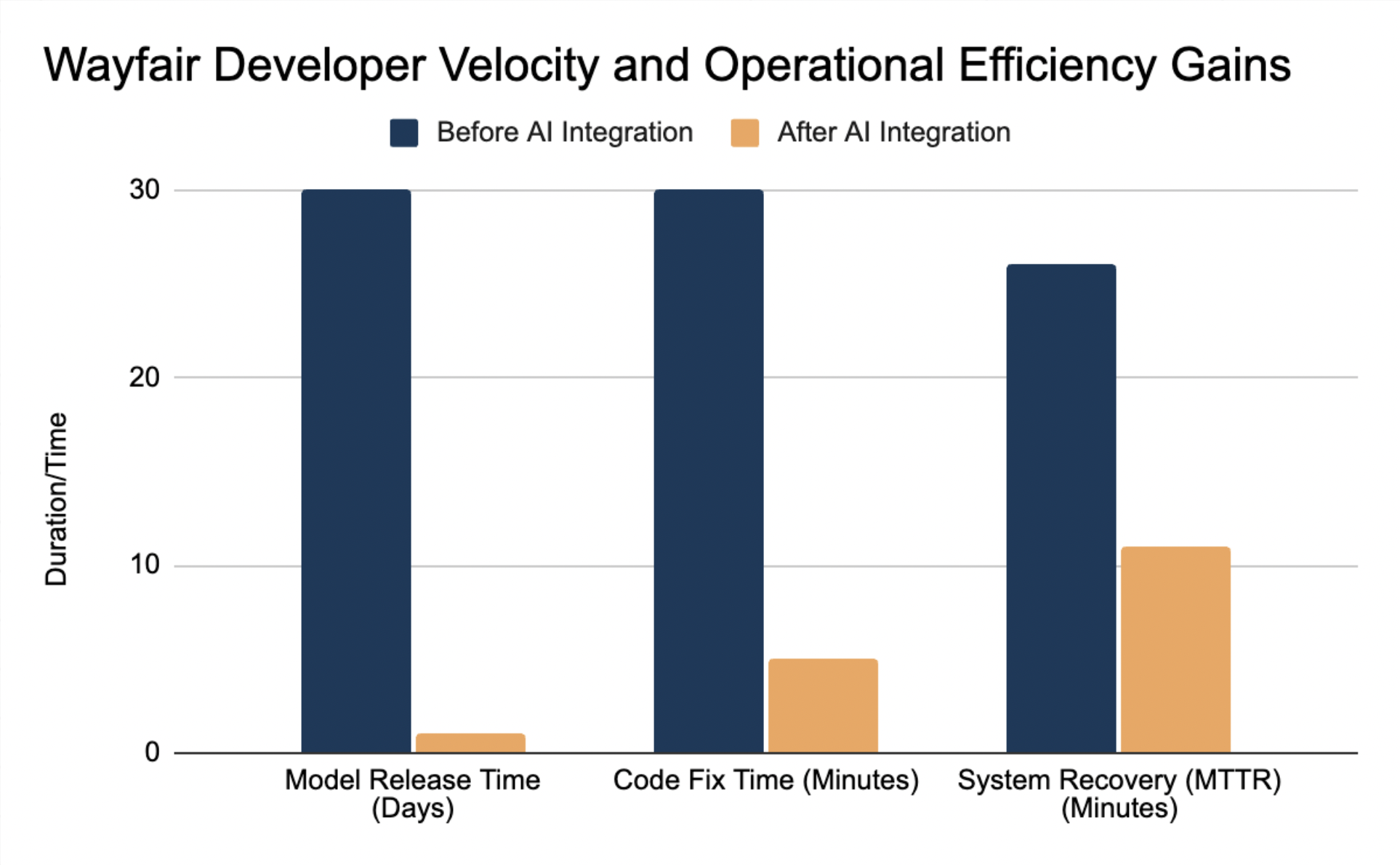
Source: Data compiled from Google Cloud's Wayfair Developer Case Study.