Top Trends in Networking for AI: Connectivity from AI Clusters to the Edge

The demands of artificial intelligence are revolutionizing every aspect of the datacenter environment. Yet arguably, no part of AI infrastructure is as challenging as networking. The streamlined throughput, distribution, and intelligence required for AI make the networking techniques of just a couple of years back look like child’s play.
This new reality has forced big changes across the IT environment. Processors are linked differently; traditional IP routing protocols can’t deliver the quality of service and performance required by AI; observability and security have changed; and data must be networked to meet specific performance requirements, which differ for AI training versus AI inference. And scale is exponentially beyond what we could have imagined just a few years back.
From Infiniband to Ethernet
This is the second year of our report on networking solutions for AI datacenters, where we explore the rapid evolution of the market, which has exploded with a rich combination of new technology from incumbents and startups alike.
While the fundamental elements of networking, compute, and storage remain from cloud and client/server environments, in AI networks they are arranged differently, connected differently, and use new protocols and observability tools.
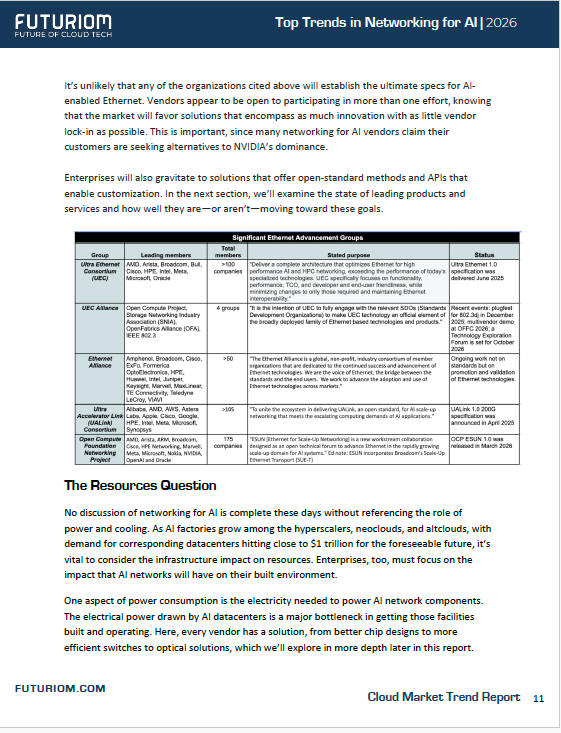
Today’s AI networks are works in progress. InfiniBand, the HPC networking technology dominated by NVIDIA, persists in large datacenters. But demand for Ethernet, the longstanding protocol for datacenter connectivity, continues to build. Alterations to Ethernet by hyperscalers and vendors working within the Ultra Ethernet Consortium (UEC) and other groups show considerable promise in correcting the congestion and latency sensitivities of networks for AI. Still, most specs remain in evolutionary mode. And there is no assurance that some significant proprietary Ethernet innovations will find their way into standards.
Key Customer Challenges Examined
This year we have split up our reports on networking for AI into two parts. This first report, Part 1, is focused on datacenters and scale across. Top Trends in Networking for AI Part 2: Inside the Rack—Energy, Scale and Developments in CPO is scheduled to appear in July. Please contact us for submissions or sponsorship inquiries.
In Futuriom’s latest report, Top Trends in Networking for AI 2026: Connectivity from AI Clusters to the Edge (free download), we look at the specific challenges facing customers, as well as emerging solutions.
Thank you to our report sponsors: Arrcus, DriveNets, and Nokia.
Following are some highlights from the report:
- Networking for AI is unprecedented in its complexity, challenging even the most technically seasoned of enterprise users. While hyperscalers have met the challenge, enterprises often struggle.
- Ethernet remains the preferred datacenter network. While InfiniBand is popular, Ethernet in the form of RDMA over Converged Ethernet version 2 (RoCEv2) is the increasingly preferred approach for hyperscaler fabrics.
- Ultra Ethernet remains an emerging standard. The Ultra Ethernet Consortium (UEC) released its 1.0 specification in June 2025. The industry supports the technology as a long-term replacement for InfiniBand.
- Networking for AI is increasingly focused on optical technology. Faced with power and space constraints, researchers and vendors are innovating with optical technologies in all areas of networking for AI.
- AI for networking is an established approach. Adding AIOps and intelligent agents to networks has become a selling point for enterprise solutions.
- The network edge is key to inference development. Services and solutions that address the need to deploy AI at the network edge are on the rise.
- Telcos are playing a role. Services to handle inference at the network edge, fueled by AI-RAN, are popping up from telcos worldwide.
Some of the companies highlighted in this report: Alkira, Arista, Arrcus, Aryaka Networks, Astera Labs, AT&T, Aviz Networks, AWS, Broadcom, Ciena, Charter Communications, Cisco, Cloudflare, Comcast, CoreWeave, Crusoe, Dell Technologies, DriveNets, Equinix, Eridu, Fastly, Fluidstack, Google, HPE, IOH, Juniper Networks, Lambda Labs, Meta, Microsoft, Napatech, Nebius, Netris, Nokia, Nscale, NVIDIA, Resolight, Runpod, TensorWave, T-Mobile, TogetherAI, Vultr, WhiteFiber, ZEDEDA
Dive in and read up! You can download the report here.