
Why Arista's New Optical Transceiver Is a Big Deal
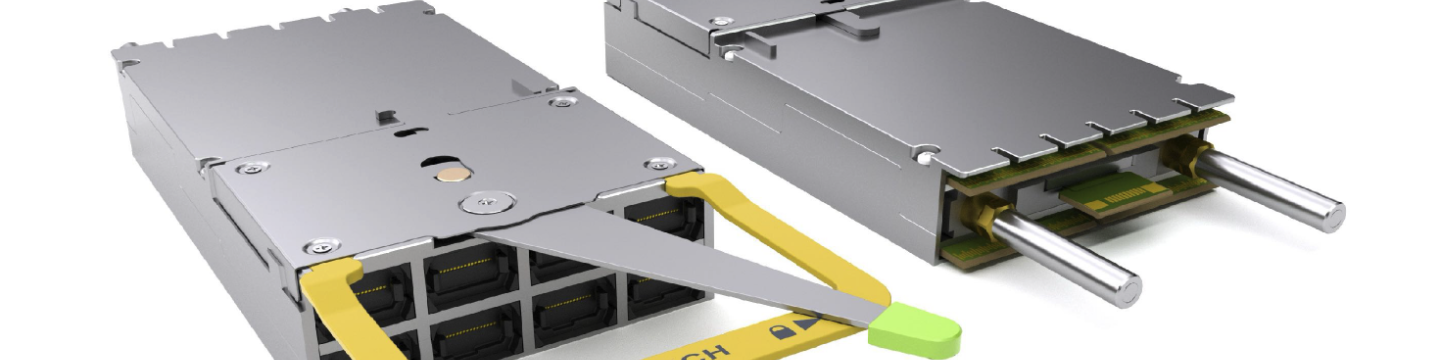
AI networks, particularly those of hyperscalers, demand more power, speed, and space than cloud networks ever did. Arista Networks thinks today’s optical transceivers are buckling under the pressure. And the networking vendor has designed a new take on pluggable optical transceivers that it claims can boost performance, reliability, and other factors dramatically.
Called eXtra-dense Pluggable Optics (XPO) nodes, the components (pictured above) will debut at the OFC conference in Los Angeles next week. And though production isn’t anticipated until 2027, Arista has assembled a multisource agreement (MSA) that includes over 40 optical equipment producers (unnamed as yet) who have pledged to build products based on the XPO spec. The goal is that all products built by members of the MSA will be interchangeable.
A Landmark In Optical Transceivers
The importance of this announcement is partly due to its optical focus. While copper connectivity remains the standard way to link rack-level elements, to connect AI clusters together within or between datacenters, fiber fits the bill. And that calls for transceivers that govern the optical-to-electrical conversions required to get the job done.
According to Andreas “Andy” Bechtolsheim, cofounder and chief architect of Arista Networks, the announcement of XPO is as significant as the 2016 introduction of the Octal Small Form-Factor Pluggable (OSFP) transceiver model that governs most high-speed datacenter transceivers today.
But, he maintains, that specification is no longer dense enough, both in physical form factor as well as bandwidth capabilities, to support AI workflows. Power and cooling are issues as well. Today’s inferencing workloads are approaching the thermal profiles—or thermal envelope—of training, says Bechtolsheim. The heat generated by individual transceiver modules is starting to hit the limits of what racks can handle.
XPO solves these issues, Bechtolsheim says. Each XPO module provides 12 Tb/s of bandwidth, compared to 1.6 Tb/s for OSFP modules. A linear interface channel improves power consumption by not requiring signal conditioning or amplification. Every module is equipped with its own liquid-cooled cold plate.
As to density, Arista says in a white paper that XPO can deliver "4X the front-panel density of OSFP, enabling up to 204.8Tbps of switching throughput per Open Rack Unit (1OU) and establishing a new benchmark for pluggable optical module density.”
Here are some further comparisons, courtesy of Arista:

Source: Arista Networks
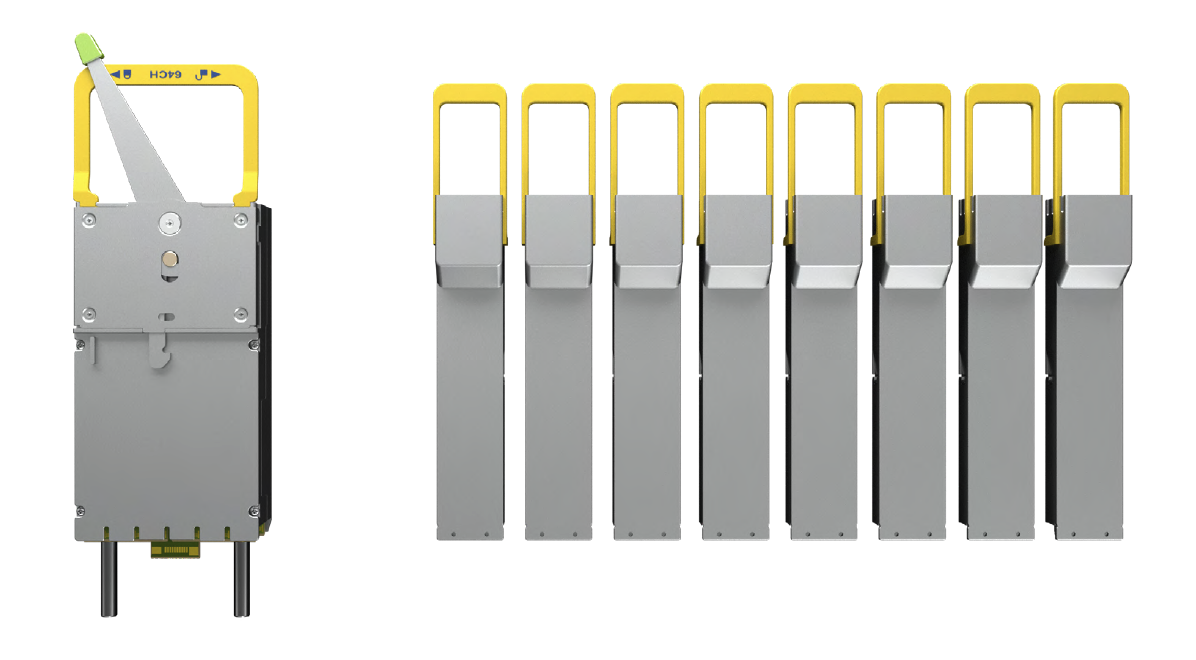
One XPO modules replaces eight OSFP modules. Source: Arista Networks
It all translates to capital savings and operational efficiencies for datacenters. Arista estimates that switch rack footprint is reduced by 75% with XPO, along with reductions in electrical infrastructure, cooling, and plumbing. This means hyperscalers could achieve better results in less space, cutting the need to expand billion-dollar facilities.
How XPO Differs from Other Techniques
There’s nothing new about the struggle to design optical transceivers that are faster, denser, and more power-efficient. Linear pluggable optics (LPO) removes the digital signal processor (DSP) from the optical module and instead relies on the DSP of the host ASIC to process signals. This shrinks the module and makes it cheaper, faster, and lower in power consumption. The problem with LPO, Arista says, is that it doesn’t solve the density problem.
Then there’s co-packed optics (CPO), an approach favored by NVIDIA in which optical-to-electronic transceivers are replaced with silicon photonics placed directly on the same substrate as the ASIC associated with the CPU or GPU. The problem there, according to Arista, is that CPO modules are enormously difficult to manufacture due to the delicate alignment of optical fibers required in each module. Scaling will be a problem, the vendor maintains.
Further Details on XPO
XPO is designed to work with the full range of optical transceiver distance specifications, including DR, FR, LR, SR, and ZR. It will also work with RF and microwave. And it will conform to the still-developing IEEE 802.3dj, a new version of Ethernet designed to run Ethernet at 200-Gb/s per lane, versus the current top spec of 100-Gb/s per lane.
Futuriom Take: Arista’s new XPO module marks a fresh and important take on optical transceiver technology. If it performs in production as planned, it could substantially reduce capex and operating costs for hyperscalers, neocloud providers, and large enterprises. Not to mention advancing the capabilities of Arista’s products.