Google Piles Into Agentic Enterprise. What Does It Mean for Others?

This week at the Google Cloud Next ’26 conference in Las Vegas, Google unleashed a clear demonstration of its cloud and AI technology firepower, with a strong message tying together its strengths in AI, security, and cloud services.
Google announced a slew of new products and services built around what it calls the Agentic Enterprise, a term gaining traction around the market for building and managing AI agents. But the real strength in Google's message comes in its integration approach, in which it brings its own AI chips, networking, infrastructure, and security to the party.
Armed with a growing presence in hybrid cloud infrastructure, highlighted in our Hybrid Cloud Index, Google is sending a message that because it has fully integrated all of the infrastructure for both cloud and AI, that can lend itself to more security and control for enterprises.
Top Public Cloud Companies in Selected Hybrid Cloud Case Studies
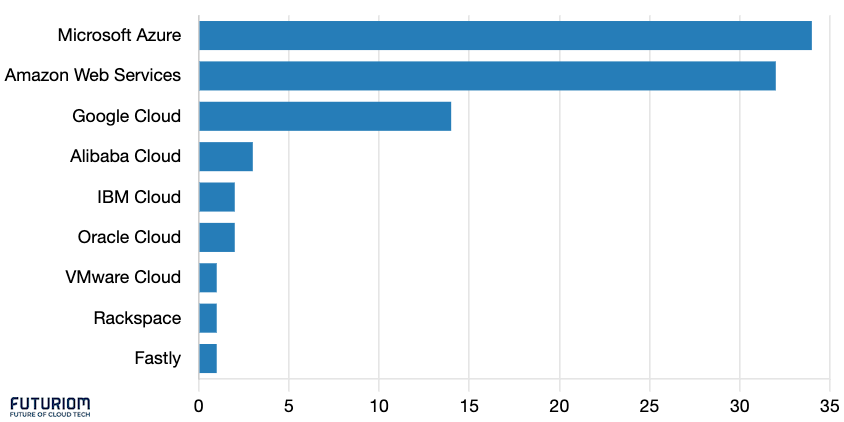
Source: Futuriom Cloud Tracker Pro
Google Cloud CEO Thomas Kurian described Google's Gemini Enterprise Agent Platform as a "single command center for pollicy ... you protect your models, you protect your proprietary enterprise data from threats such as sensitive data leakage," he said in the Cloud Next keynote. "This integrated approach, from secure sandboxes to a single management console, provides the visibility and isolation to run your most sensitive workloads with a high degree of confidence."
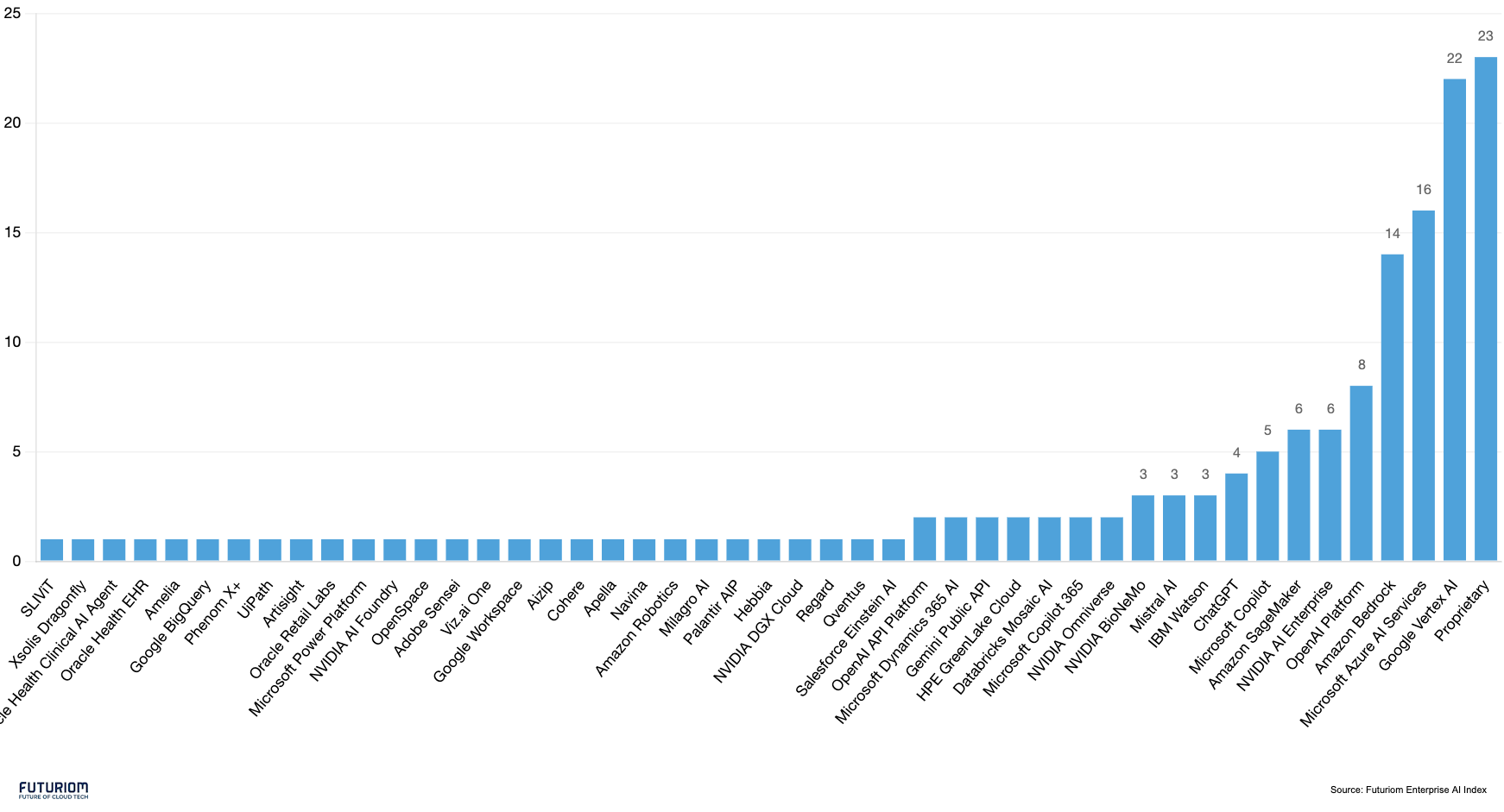
The Gemini Enterprise Agent Platform, which incorporates and replaces Vertex AI, is a proven favorite among enterprises, according to Futuriom research, so that will prove an important foundation for its growth. In addition, Google's messaging follows along the lines of what enterprises have been demanding for AI: proprietary platforms that they can control, along with industrial-strength security. According to our database cut of "AI Platforms for Multiple Verticals" that we track, Google is #2 in the category behind #1, which is proprietary platforms (Cloud Tracker Pro subscription required to access data).
With Gemini Enterprise Agent Platform, Google has taken Vertex AI and added an army of services for creating, orchestrating, securing, simulating, tracking, and monitoring agents in Google Cloud. They have also added Model Context Protocol support and specialized agents from an Agent Marketplace that work with Atlassian, Box, Oracle, ServiceNow, Workday, and other enterprise systems and applications.
Strengthening a Multivendor AI Architecture
To support all these services, Google Cloud has unveiled additions to its AI Hypercomputer architecture for datacenter AI, which incorporates new processors, storage, and networking elements, including the following:
- TPU 8t, optimized for training, which can scale up to 9,600 TPUs and 2 PB of shared, high-bandwidth memory in a single superpod. Google says it achieves 3x the processing power of its Ironwood predecessor and delivers up to 2x more performance/watt.
- TPU 8i, optimized for inference, directly connects 1,152 TPUs in a single pod. Google says it delivers 80% better performance per dollar for inference than the prior generation and supports millions of concurrent agents.
- Google Axion N4A instances of Google’s custom Arm-based Axion CPUs, which Google says provide twice the price/performance compared to current-generation x86-based VMs.
- Google’s Virgo Network, an AI-optimized fabric for training that links either NVIDIA Vera Rubin NVL72 systems or TPU 8t superpods into massive supercomputers packing hundreds of thousands of accelerators.
On the AI services front, these integrations demonstrate a key competitive advantage that Google will have against a vast array of enterprise AI startups, whether it's Amazon, Microsoft, OpenAI, or Anthropic. That is, Google controls its own cloud infrastructure, AI models, and chips. This has the benefit of reducing costs, because Google owns both its own proprietary models (Gemini and others), as well as giving it control over integrations and security of its infrastructure. Most competitors must buy one or the other from somebody else.
For the vendors in the enterprise software category, these announcements should be terrifying. The stocks of enterprise software leaders such as Microsoft, Oracle, Salesforce, and ServiceNow have been dumped as investors question the threat that agentic AI will be to the future of enterprise software. With these announcements, Google is clearly increasing its presence in these markets.
Despite this threat, Google says it's playing nice and partnering with enterprise software as well as other infrastructure companies. Throughout these announcements, Google said it will support a multivendor approach. Its AI Hypercomputer supports NVIDIA chips and Intel processors. And in a new Agentic Data Cloud service, Google’s created a Cross-Cloud Lakehouse, based on Apache Iceberg, that lets customers query data from AWS or Azure without the expense of moving data out of those clouds. It's also providing integrations with Microsoft Office 365.
This multivendor support is what enterprise customers have been asking for and should draw interest in Google Cloud’s agentic service offerings. It also sends a strong message to competitive enterprise and startups alike: Google intends to be a leader in this market.
More Security Added
Google Cloud has improved its security for agentic AI, with a number of offerings from Wiz, which it bought for $32 billion recently. These include the Wiz AI Application Protection Platform (AI-APP); Wiz Red, Blue, and Green Agents, which identify and remediate risks; and a new Wiz Agentic Workflows hub for orchestrating AI and cloud security in Wiz.
Google’s also added its own Agentic SecOps solutions, including Dark Web Intelligence, which builds a profile of an organization, then uses Google Threat Intelligence Group’s data to identify only the threats that apply to that company. A Threat Hunting Agent lets security teams discover attack patterns proactively. And a Detection Engineering Agent automates threat detection rules.
Google’s also introduced Google Cloud Fraud Defense, a platform evolved from reCAPTCHA to identify humans, bots, and agents in order to provide an extra layer of web security.
Bringing It All Together
Google Cloud has introduced a lot this week so far. Indeed. To streamline things, Google has created a fund of resources and incentives to help its ecosystem of software partners, channel partners, systems integrators, and consulting firms help customers implement agentic AI. Part of the plan is to forward early-stage models to firms such as Accenture, BCG, Deloitte, and McKinsey in order to get feedback for further development.
Futuriom Take: The integration challenges of the agentic enterprise has been a strong theme among startups and enterprise companies Futuriom has been following, fueling interest in new AI enterprise platform technologies, whether it's companies in data management or security. At Cloud Next, Google sent a strong message that it intends to be a leader in this movement. What's not clear is how the delicate balance of "coopetition" with other enterprise software and cloud companies will unfold, as many of Google's offerings appear to be competition and contributing to the recent "SaaSmageddon" trend.