Arista Moves Faster Into AI and Campus Markets

Arista Networks has this week released a triple-header announcement aimed at the enterprise campus. Included is Arista VESPA, a significant wireless WAN software upgrade to the vendor’s EOS operating system; an Arista AVA platform for EOS-driven agentic AI; and a pair of ruggedized switches for the network edge. All are scheduled for release in the first quarter of 2026.
Arista is well-known leader in datacenter and enterprise networking, with 30% year/year revenue growth. It has been gaining market share in enterprise networking and has a reputation for high-quality engineering and a reliable operating system, EOS. It has also made a name for itself in networking infrastructure for large AI deployments, including both training and inference datacenters.
The collection of these new announcements is typical of Arista's approach: it shows a thoughtful, technical approach to extend the reach and scale of EOS to new markets. Although Arista has been shipping products in the campus networking and WLAN markets for several years, these announcements show that Arista is stepping up its game and willing to make investments to gain new market share in what is a crowded market with Cisco, HPE/Aruba/Juniper, Extreme Networks, and many others.
VESPA Aims at Massive-Scale WLAN
Arista’s first announcement: Arista Virtual Ethernet Segment with Proxy ARP (Arista VESPA) deploys clever technology that brings datacenter-level scaling to the wireless networks found in universities, factories, convention centers, and other campus-oriented environments.
This software upgrade to EOS eliminates a key bottleneck Arista says has limited WLAN scale in the past—namely, the controllers used in legacy campus networks. These, Arista says, are set to handle multiple mobility domains, complicating the network, creating user chokepoints, and limiting failover.
“Arista VESPA is the architectural imperative, applying high-scale data center principles like EVPN to campus network design,” wrote Kumar Srikantan, VP and GM of Cloud Fabric Networking, and Sriram Venkiteswaran, Senior Director of Product Management, Campus, in a blog about the announcement. “It fundamentally breaks the controller dependency, enabling a single, massive roaming domain supporting over 500,000 clients with high resiliency and fast failover.”

Source: Arista
Arizona State University is an early adopter of VESPA. “In transitioning to Arista’s controller-less Wi-Fi, we’ve partnered with them to help shape and validate the development of Arista’s VESPA architecture,” stated Jorge De Cossio, Senior Director, Digital Infrastructure, Enterprise Technology for ASU, in the press release.
Aiming at Campus TAM
By breaking the controller limits in campus WLANs, Arista is sending a clear message that it wants to compete against Cisco and HPE Aruba in wireless networking at scale. It’s not a new message: Arista’s campus focus has been growing over the past few quarters. The hiring of Todd Nightingale as president and COO this past summer was a significant move, given his past as SVP and GM Cisco’s Meraki division. Likewise, Arista’s acquisition of the VeloCloud SD-WAN portfolio from Broadcom earlier this year has also contributed to its campus technology roster.
“Clearly, AI and campus are going to grow and do great guns for us, as it should, because they’re two very large TAMs,” said Arista CEO Jayshree Ullal on the company’s Q3 earnings conference call in November. “These two are going to grow substantially in double digits.”
AVA Smart Agents and Industrial Switches
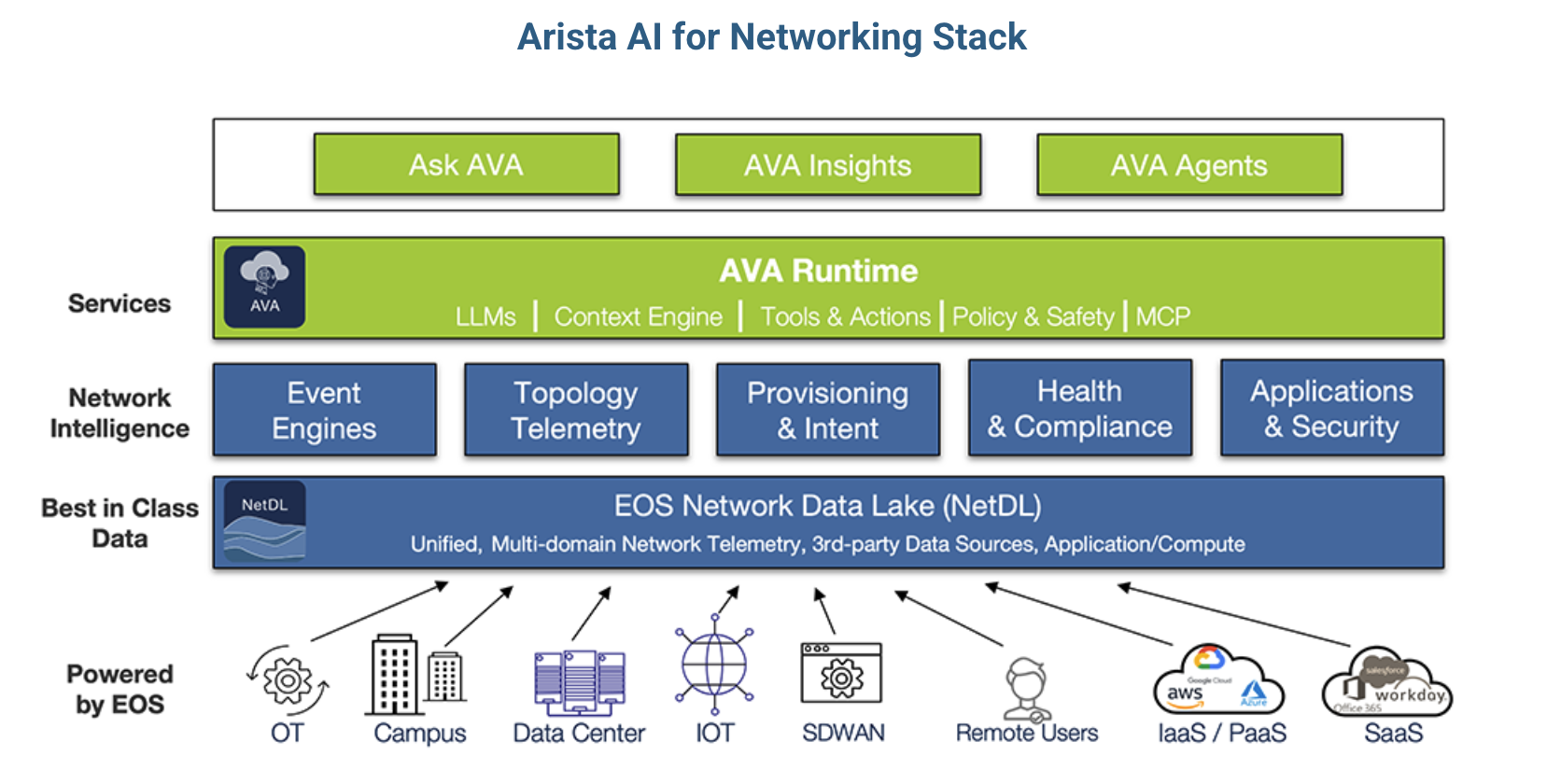
Arista also unveiled Autonomous Virtual Assist (AVA), an AI-based assistant for network operations. AVA draws on data in EOS and Arista’s network source of truth, its Network Data Lake (NetDL), as well as the network intelligence that already exists in the vendor’s CloudVision management platform. It uses this context to monitor devices, detect anomalies, furnish proactive insights about network activity. Ultimately, AVA agents will be introduced that take action in response to events.
Source: Arista
Arista’s two new ruggedized switches, the A 20-port Din Rail switch and a 1RU Fixed switch, are designed for harsh environments in factories, smart city networks, gas stations, parking lots, stadiums, and other places where the network edge meets shock, weather conditions, humidity, vibration, and corrosion. Both switches work with EOS and CloudVision.
Campus Edge in the Crosshairs
Arista is mounting a major push into campus networking, bringing technologies from datacenter and hyperscaler products and services to improve performance and scalability at the network edge. This is a prescient move, as the edge is where AI applications rely for input from devices as well as for user interaction. And according to CEO Ullal, this is where customers need more help.
Indeed, on the Q3 earnings call, she stated that AI and campus will grow faster short term than Arista’s core datacenhttps://admin.futuriom.com/adm... business: “Our customers are putting more attention there [on AI and campus]… [T]he existing business, which is already on very large numbers, will have lesser growth,” she said.
Investors didn’t like that message last month. But today, the stock rose a bit on the campus news and was trading at $131.90, +1.86 (1.43%).
Futuriom Take: With its latest spate of announcements for WLAN, agentic AI, and the ruggedized network edge, Arista is moving aggressively to address demand for campus networking solutions with technologies developed for datacenter and hyperscaler networks. It’s a strategy that investors balked at last month, but it may prove to be a catalyst for significant future growth. Futuriom believes this is the correct strategy.